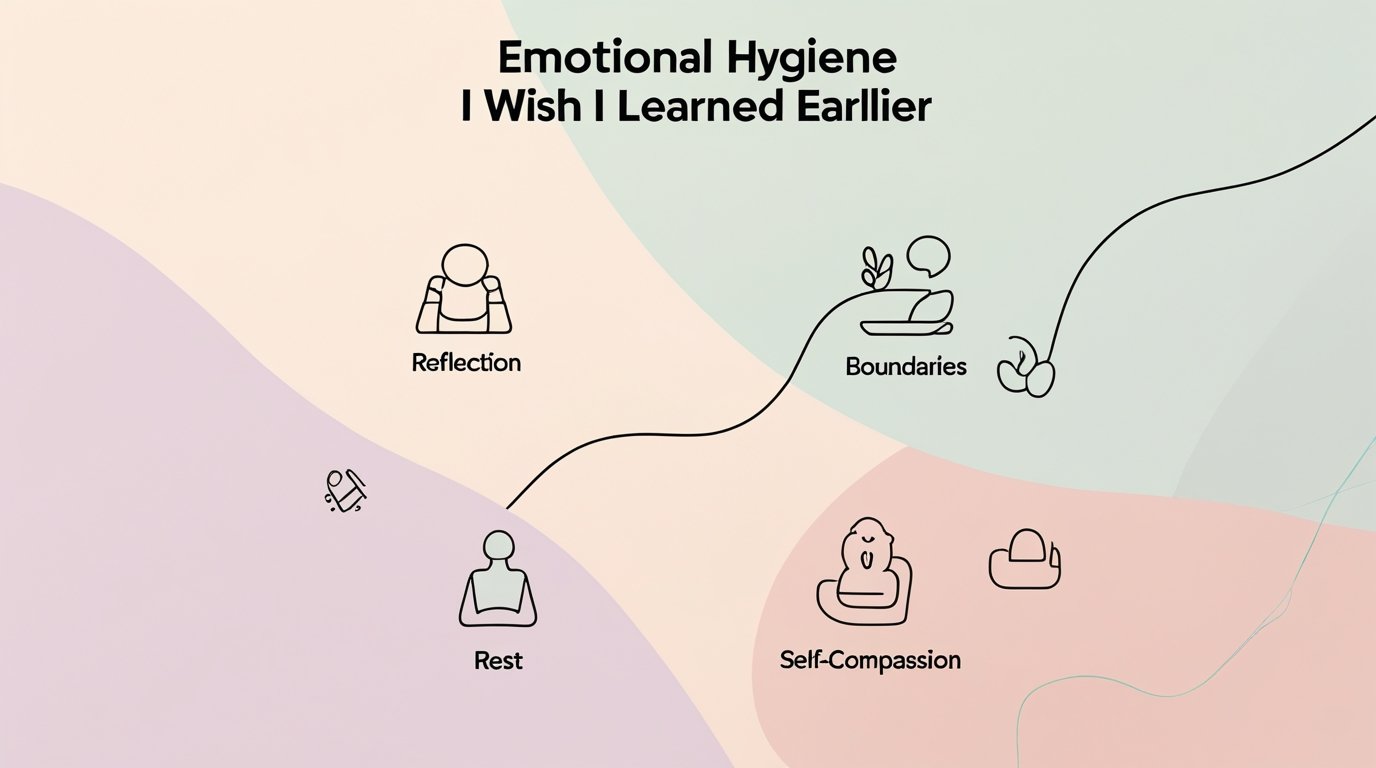
For the longest time, I thought that “hygiene” ended at the bathroom door. I was the person who never missed a morning shower, flossed religiously, and kept my kitchen counters sterile enough for surgery. But inside? Inside, I was a walking junkyard. I was carrying around resentment from a 2018 argument, the rotting remains of a “failed” project, and a thick layer of daily stress that I just assumed was a permanent part of my personality.
When I finally hit a burnout so severe that I couldn’t get out of bed, not because I was tired, but because I was “emotionally heavy”, I discovered Emotional Hygiene. These are the protocols I’ve developed over the last few years. They are simple, they are free, and quite frankly, they are the only reason I am still a functioning, happy human being.
The Concept of “Emotional Plaque”
Just as plaque builds up on your teeth if you don’t brush, “emotional plaque” builds up in your psyche every time you experience a micro-stressor that you don’t process.
1. The Cumulative Effect:
I used to think that “letting it go” meant just ignoring it. If someone was rude to me in traffic, or my boss gave me a passive-aggressive comment, I would push it down. But emotions are energy. If you don’t “excrete” them, they don’t disappear; they just change form. For me, they changed into chronic tension in my shoulders and a short fuse with the people I loved.
2. The “Stale Emotion” Test:
I started asking myself: “Is this a fresh feeling, or am I reheating an old one?” If I’m angry about a late bill today, but I’m using the intensity of a childhood memory to fuel that anger, I have a hygiene problem. I’m living in a “dirty” emotional environment.
The “Brain Dump” (The Morning Scrub):
The single most effective hygiene practice I’ve adopted is the Morning Pages or the “Brain Dump.” Every morning, before I check my phone or talk to another person, I write three pages of absolute nonsense.
- It’s not a journal: I’m not writing for history. I’m “venting the pipes.” I write about how I didn’t sleep well, how I’m worried about a deadline, or how the neighbor’s dog is annoying.
- The Result: By the time I finish, I feel like I’ve emptied the “trash bin” of my mind. I can walk into my day without that morning fog of low-level anxiety. It is the mental equivalent of brushing your teeth.
The “Emotional Check-In” (The Mid-Day Rinse):
We check our watches and our bank balances ten times a day, but how often do we check our “Internal Weather”? I started setting a silent alarm for 2:00 PM, the peak of the workday chaos.
1. HALT: The Diagnostic Tool:
When the alarm goes off, I check for the four big hygiene “germs”:
- Hungry?
- Angry?
- Lonely?
- Tired?
I realized that 80% of my “existential dread” was actually just me being dehydrated or needing a five-minute walk. Emotional hygiene is about catching the “infection” before it turns into a fever.
2. The 90-Second Rule:
I learned from neuroanatomist Jill Bolte Taylor that a physical emotional surge only lasts 90 seconds. After that, if you’re still angry, you are choosing to stay angry by replaying the story.
- The Practice: If I feel a surge of rage, I set a timer. I feel it, I let it wash over me like a wave, and I don’t touch the “story.” Usually, by the time the timer dings, the “hygiene” is done. The feeling has passed through the system.
Setting “Emotional Boundaries” (The Protective Gear):
You wouldn’t let a stranger walk into your house with muddy shoes and wipe them on your white rug. So why do we let people dump their “emotional mud” on us?
1. The “Vent” vs. “Dump” Distinction:
I had a friend who would call me and complain for forty minutes about the same issue every week. I realized I was her “emotional landfill.”
- The Change: I started asking: “Do you need me to listen, or are you looking for a solution?” If they just want to dump, I set a boundary. “I have 10 minutes to listen, then I have to go.” Protecting your emotional space is not mean; it’s essential.
2. The “Digital Gating”
Following accounts that make you feel inadequate or angry is like voluntarily drinking poisoned water. I did a “Hygiene Audit” of my social media. If a creator’s content left me feeling “dirty” or “diminished,” I hit unfollow. Your “input” dictates your “output.”
The “Forgiveness” Protocol (The Deep Clean):
Forgiveness isn’t about the other person; it’s about cleaning your system. Holding onto a grudge is like carrying a bag of rotting garbage everywhere you go, hoping the other person will eventually smell it.
- The Reality: The person you hate is likely eating dinner and enjoying their life. You are the only one suffering.
- The Practice: I started doing “Release Exercises.” I write a letter to the person I’m angry with (and I never send it). I say every terrible thing I want to say. Then, I burn the paper. It sounds cliché, but the physical act of “releasing” that energy is a powerful hygiene move.
The “Nightly Review” (The Evening Shower):
Just as I wouldn’t go to bed covered in the day’s sweat, I don’t go to bed covered in the day’s stress.
1. The “Three Wins”
Before I sleep, I write down three tiny wins. It could be as small as “I made a really good sandwich” or “I didn’t yell at that guy who cut me off.” * Why it works: It “re-wires” the brain to look for the clean parts of the day. It prevents the mind from “ruminating” on the negative, which is the leading cause of “emotional insomnia.”
2. The “Forfeit”
I pick one thing that didn’t go well today and I “forfeit” it. I literally say out loud, “I am leaving the frustration of that meeting in today. It does not get to come into tomorrow.”
Rumination vs. Reflection:
This was the hardest lesson. I used to think that thinking about my problems was “solving” them. But I was actually just “ruminating.”
- Rumination is a Loop: It’s “dirty.” It’s “Why did I do that? I’m so stupid.” It goes nowhere.
- Reflection is a Line: It’s “I did that because I was tired. Next time, I will prepare better.” It moves forward.
- The Hygiene Move: If I catch myself in a loop, I stand up and change my physical environment. You can’t think your way out of a loop; you have to move your way out.
Compassion as a Cleanser:
Self-criticism is the most “toxic” chemical we have. It erodes our self-worth and makes us brittle. I replaced my “Inner Critic” with an “Inner Coach.”
- The Coach’s Language: Instead of “You messed up again,” the Coach says, “Okay, that was a tough one. What’s the next right move?” * This shift in internal dialogue changed my “emotional pH” from acidic to balanced.
Conclusion:
Emotional hygiene is a lifelong practice. Some days, your mind will be a mess, and that’s okay. The goal isn’t “perfection“; it’s “regularity.” By cleaning your mental pipes through writing, setting boundaries, and releasing old grudges, you create a space where joy can actually grow.
You deserve to live in a mind that feels clean. You deserve to wake up without the weight of yesterday’s garbage. Start small, do a “HALT” check today. Your future self will thank you for the clarity.
FAQs:
1. How long does it take to see results?
The “Brain Dump” works almost immediately. The deeper stuff, like letting go of resentment, can take weeks of consistent practice. Think of it like a fitness routine—you don’t get fit in one day, but you feel the “pump” right away.
2. Can I do this if I have a busy schedule?
Yes. Most of these take less than 5 minutes. The HALT check takes 30 seconds. Emotional hygiene is about consistency, not duration.
3. Is this the same as “Toxic Positivity”?
No. Toxic positivity is pretending everything is fine when it’s not. Emotional hygiene is the opposite—it’s acknowledging the “mess” so you can clean it up. It’s about being honest, not just “positive.”
4. What if I can’t stop ruminating at night?
Try the “Cognitive Shuffle.” Think of a word (like “Bed”). Then think of every word you can that starts with B (Ball, Bear, Boat), then E (Egg, Eagle), then D (Dog, Door). It “scrambles” the logical side of the brain that wants to ruminate and helps you slide into sleep.
5. How do I tell someone they are “emotionally dumping” on me?
Be kind but firm. “I really value our friendship and I want to support you, but right now I don’t have the emotional capacity to hold this much. Can we talk about something lighter for a bit?”
6. Do I need a therapist for emotional hygiene?
While these tools are great for daily maintenance, they are not a replacement for professional help. If your “emotional plaque” has turned into a “deep infection” (like clinical depression or trauma), a therapist is like the “dentist” you need to see for a professional cleaning.